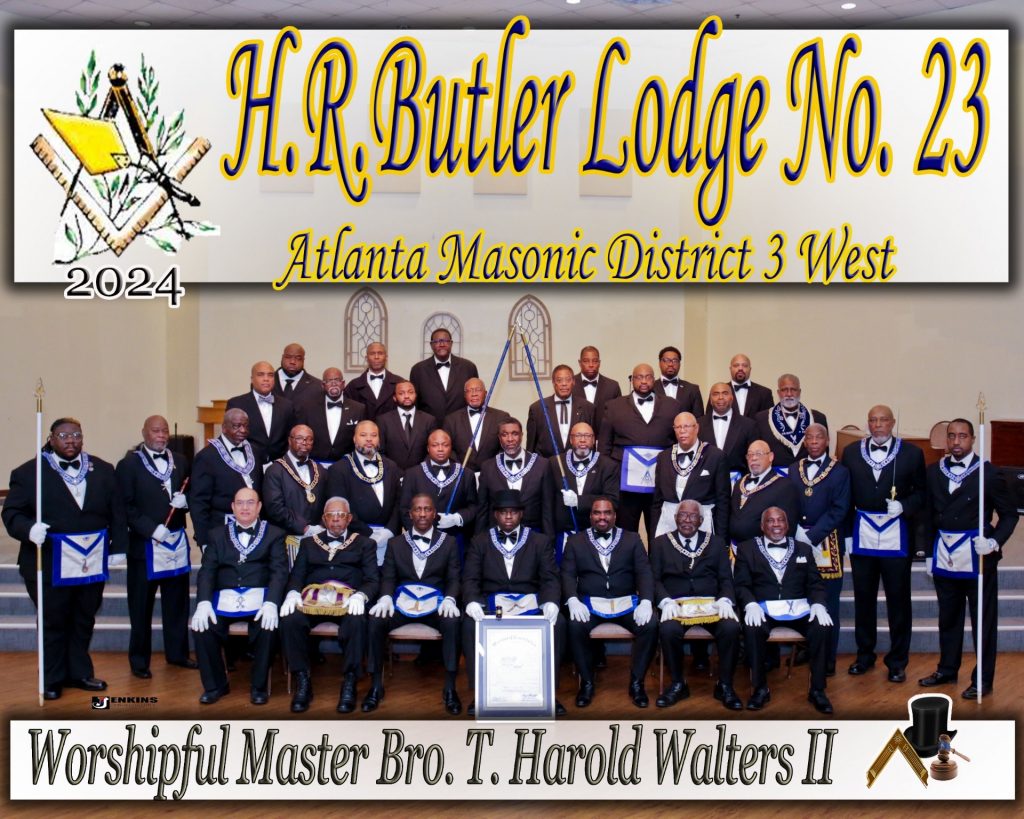
H.R. Butler Lodge No. 23 F. & A.M.

“As a race, we are too backward in the matter of recording our history. We are too prone to leave it to the other fellow and when he twists it,
we are never able to correct it. Let us take time by the forelock and historically establish our legal right to this Masonic
Jurisdiction so if ever an occasion call for it,
we would not have to depend upon any body but ourselves.”
- Dr. Henry Rutherford Butler, GM (June 21, 1921)
|
T |
he history of H.R. Butler Lodge No. 23 grew out of the merger of Rising Sun Lodge No. 23, Progressive Lodge No. 181, and Refuge Lodge 243. The merger was precipitated as a result of the Depression of 1929, whereby the membership decreased drastically in numbers and the need for internal Grand Lodge intervention to recognize the Lodge system within the state became a necessity.
Rising Sun Lodge No. 23 was chartered on June 20, 1887 in Atlanta, Georgia by the Most Worshipful Union Grand Lodge, Ancient Free and Accepted Masons for the Jurisdiction and state of Georgia, under the stewardship of Grand Master Alexander Harris. This Lodge and St. James Lodge No. 4 were the only Lodges within the Masonic district of Atlanta during this period. From this noble inception, Rising Sun Lodge No. 23 established and maintained the highest Masonic standards that were in keeping with the Charter issued from England to Prince Hall and others of Boston, Massachusetts in 1784, where we and all regular Prince Hall Masons trace their linage.

The Masters and Wardens of Rising Sun Lodge No. 23 were Masons of substance and often the most honorable members of our race at that time. These officers were held in high esteem within the Lodge, their communities and in their professional endeavors. They had set a fine example and constantly admonished the membership of guarding over their outward demeanor and being upright men and Masons in their laudable undertakings. The members of Rising Sun met regularly and conducted their affairs according to Masonic customers and tradition by learned members of the Craft, Collectively, they attended to the sick, funeralized their dead and consistently contributed to the relief of their deserving Brethren, their widows and orphans. The caliber of Masons who made up the membership of Rising Sun were always at the forefront in their Masonic endeavors and constantly inspired leadership, dedication and demonstrated ability, to include providing assistance to coexisting Lodges within the district. Past Masters and members such as, George B. Nichols, E. B. Gibson, Edward Williams, J. Verdelle, L. D. Milton, J. B. Blayton, C.R. Yates, W.L. Murdaugh, Bishop W.A. Foundation and Robert Paschal, and a host of others who were instrumental in keeping the lodge in a steady and harmonious state, provided leadership, guidance and the business sense in influencing the Lodge direction and prosperity.
Progressive Lodge No. 181 and Refuge Lodge No. 243 were also outstanding in their Masonic and civic attributes. Both were chartered in the early 1900’s. Progressive Lodge No. 181 was located was located in Dixie (Hill) and came into existence as outgrowth of the Progressive Whist Club. This Club was composed of young fraternal Brethren who had created a bond of friendship and morality. Because of their belief in the Fatherhood of God and the Brotherhood of Man, they were encouraged to petition for a Lodge. Each member pledged his support of the Lodge equally as well as they had faithfully supported their club. Their petition was approved and they were established as a Progressive Lodge of Masons. Past Master A. McClendon was raised in Progressive Lodge No. 181 in 1911, along with Brother John Wesley Dobbs. Both served as its Master and the latter became Grand Master of the State and Jurisdiction. Past Master McClendon served as the Lodge’s Secretary for about nine years, one year in each Wardens position. After serving as Master, he was elected Treasurer. He served in this capacity until the merger of the three Lodges, where he was subsequently elected Treasurer of H.R. Butler Lodge No. 23. He held this position until 1958 and was succeeded by Brother Robert J. Walters. Progressive Lodge No. 181 benefited from the strong relationship of Worshipful Master John W. Dobbs, C.W. Reeves, Daniel T. Robinson, MD, and W.H. Ragin, who had a wealth of Masonic Knowledge and experience.
Refuge Lodge No. 243 was also chartered in Atlanta. It advanced in membership and excellence as did the other Lodges in the area. By 1920 the Lodge had 96 members on its roll. One of its noteworthy Past Masters was Brother Irvin McDuffie, who served the Lodge in several of its stations before becoming the Master. He played an active part in the Lodge’s growth and he inspired Masonic learning and support of the Lodge. Past Master McDuffie later became the valet and personal attendant to the President of the United States, the Honorable Franklin D. Roosevelt. He returned to the Lodge in 1938 when its name had changed and was given the honor of presiding over it. He reminded the Past Masters who served Refuge Lodge were: Maurice Woodward, T.H. Slater, MD, J.F. Middleton, J.B. Stroud, Arthur Winston and Robert H. Herndon. Brother John T. Gill joined Refuge during the merger and subsequently became the Master of H.R. Butler Lodge No. 23.

The Depression of 1929 left it devastating mark upon the Masonic Jurisdiction because of economic conditions and the need for employment. Many members left the state to seek employment in other parts of the United States. The impact of this occurrence transpired within a course of three years. The growth of nineteen Lodges in the Atlanta District consisted of 1472 members. This situation caused this number to drop to ten active Lodges, with a membership of 747. Rising Sun and Refuge was hanging in the balance. From 1929 to 1932, Rising Sun membership decreased from 133 to 12 in number. The condition of Lodges was of profound concern to the Prince Hall family. Lodges officers and members came from all over the state and pleaded with Grand Master Dobbs to save Masonry.
Moreover, on January 28, 1933, Grand Master Dobbs called the Grand Lodge in Executive Session in Macon, Georgia to come to grips with this and other problems within the Jurisdiction. In Grand Master Dobbs opening remarks, he said, “Grand Master W.E. Terry was the father of our Masonic home; Grand Master H.R. Butler gave us the Masonic Relief Association (MRA) and expanded our Order to its present growth, now it falls to my lot as your Grand Master today to save the work and labor of these illustrious predecessors.” Upon the advice and recommendations of the Grand Lodge attorneys, mergers and the other economic means were accepted by this august body. This landmark decision is the consequence of our existence and continuing health of Masonry within this Jurisdiction.
The Grand Master executed his plan and began to recognized, merge, reinstate defunct Lodges and bring back members of Rising Sun, Progressive and Refuge Lodges. He was instrumental in building up the Lodge’s membership because he was then the sitting Master. On September 20, 1935, letters were dispatched to Refuge Lodge and four others within the Atlanta district, notifying them that in keeping with the authority granted at the Sixty-Fifth Grand Lodge Communication, these Lodges would be merged with the five oldest Atlanta Lodges. On December 27, 1935, Progress Lodge No. 181, Refuge Lodge No. 242 and Rising Sun Lodge No. 23 became H.R. Butler Lodge No. 23. The “23” was retained and assigned to the new Lodge in accordance to Masonic Custom, that being, the oldest number is retained. The Lodge was named in honor of the Jurisdiction’s ninth Grand Master; Dr. Henry Rutherford Butler, who served as Grand Master from 1900 to 1931. With the advent and passing of the Depression, the Lodge was in a state of transition because the economic and social conditions of the country and state were favorably changing. All the true and real Masons were once again returning to the Lodge. As a consequence of better times and better money circulation, the best of men came knocking at the Lodge door for admission. The officers and members met the challenges in which they were confronted and labored strenuously in building the membership with better men in the name and cause of Masonry.
From the date of H.R. Butler Lodge No. 23’s inception, the lodge started out with some of the best Masonic scholars, ritualistic and professional businessman within the Jurisdiction. The talents these men brought into the Lodge through this merger were exceptional and balanced according to the Lodge’s needs. Each member who was fortunate to serve in the Lodge’s highest office did so with distinction. Each Master made his contribution in his own selfless manner; instituted noteworthy landmark decisions and brought the Lodge forward in superlative style. Accordingly, it was apparent that H.R. Butler Lodge No. 23 pooled its resources and adhered to the tenets of Faith, Hope and Charity, coupled with the fostering of a common virtue; Brotherly Love and Favor. A debt of gratitude is owed to men like Grand Master Dobbs, Thomas Slack, John T. Gill, Thomas H. Slater, and H. Carroll, to include the membership who also made all this possible and set the standards for those who followed their lead.
The Lodge has met on a regular basis in the Lodge room above Hanley’s Funeral Home on Bell Street, as previously was done before the merger. In 1935 the Lodge moved and met in the Herndon Building, and in 1936 a move to the Odd Fellow’s Building was inevitable. The Lodge was scheduled to move into the current Grand Lodge Building on 330 Auburn Avenue in 1938, but some unavoidable circumstances delayed this occurrence until 1940. During this year, all five Lodges and the female auxiliary made the transition. The business of the Lodge continued.

Throughout the years H.R. Butler Lodge No. 23 has dedicated itself to the principles and standards of its founding fathers and has kept the Masonic tradition alive through its teaching and the promulgation of its ancient precepts. The Lodge has upheld its obligations to coexisting Lodges, the Order of the Eastern Star Chapters and its civic responsibilities. The lodge has instituted worthwhile programs and projects which have been instrumental in its growth and health as a first class Lodge of the highest caliber. Some significant events that occurred in the past: Brother C.E. Protho was the first to be appointed to the created position of Assistant Secretary. This position came about because of the Lodge’s growth and business activity; the establishing of a Fellow Craft Club to perfect a degree team; financial investment endeavors; ritual memorization; establishing a funeral team; picketing with students to tear down discrimination within the city; contributing to the NAACP endeavors and obtaining life membership therein; supporting the National Urban League; Butler Street YMCA sponsorships; support of local churches, and other worthwhile Lodge and civic functions to show concern for those things that “ought” to be done, as envisioned and acted upon in 1887, 1935 and even today.
On August 6, 1948, Brother Amos Daniel expressed the need for the Lodge to have a set of By-laws. On June 20, 1975 DDGM George Sturdevant voiced the same necessity. Several of the Masters had unsuccessfully attempted to obtain a Warrant in the Name of H.R. Butler Lodge No. 23, instead of the Warrant of Rising Sun No. 23 that was being used over the years. On January 1960, Grand Master Dobbs recommended to the Lodge that the history should be recorded this year and thereafter every five years. These three things got lost somewhere as the Lodge progressed on with the business at hand...